
Operational Optimization and Physical Action for Utilities
Connect operational priorities with informed decisions and controlled action across utility assets and infrastructure.
Discuss your application ↘Improve Utility Operations Within Defined Constraints
Utilities balance service continuity, equipment availability, energy use, workforce capacity, and changing demand. Decisions made in one part of the operation can affect the rest of the network. A dispatch choice may influence response time. An equipment adjustment may affect operating margins. A demand-management action may reduce load while creating new constraints for customers or connected assets.
Physical AI and Artificial Intelligence of Things (AIoT) can help bring these factors into a common decision process. The approach combines relevant field observations with asset status, operating rules, and business priorities. Artificial intelligence (AI) can then support analysis and recommendations, while defined interfaces and authority controls determine whether a proposed action can proceed.
The objective is not unrestricted automation. It is a decision process that makes tradeoffs visible, respects engineering limits, and gives operators a clear way to review, authorize, and verify actions.
Optimize Against the Conditions That Matter
An optimization effort should begin with a specific operating problem and a measurable objective. Depending on the utility workflow, that objective may involve improving response time, coordinating available crews and equipment, managing energy use, or balancing demand across network assets. The objective must be considered alongside service, safety, quality, equipment, and regulatory constraints.
For example, a distribution operation may need to prioritize field response across several service areas while accounting for crew availability, asset condition, access restrictions, and the urgency of reported events. A generation or facility operation may evaluate operating adjustments against demand, equipment limits, and efficiency targets. These are candidate workflows for requirements assessment, not claims of an existing deployment.
Operational objectives
Throughput, energy consumption, resource utilization, and response time.
Engineering constraints
Equipment ratings, service requirements, safety rules, and approved control limits.
Competing priorities
Clear priorities when operational objectives conflict with one another.
Establish the Objective and Constraints
Define the operational measure and the boundaries within which optimization can take place.
- Define the operational measure, such as throughput, energy consumption, resource utilization, or response time.
- Record constraints that cannot be traded away, including equipment ratings, service requirements, operating procedures, safety rules, and approved control limits.
- Identify competing objectives and decide how priorities are set when they conflict.
Build Decisions from Operational Context
Use relevant operating information with identifiable sources, timestamps, units, and quality status.
- Current network or facility state and asset availability.
- Equipment condition, sensor measurements, and demand forecasts.
- Work schedules, business rules, and operating restrictions.
- Flags for stale readings, missing telemetry, uncertain asset associations, and conflicting records.
Account for Changing Operating Conditions
A recommendation suitable during normal operation may not be appropriate under every condition.
- Outages and maintenance windows.
- Abnormal weather and restricted switching conditions.
- Changes in demand and equipment availability.
- Review, abstention, or escalation when evidence falls outside evaluated conditions.
Make Tradeoffs Visible
Present operating options alongside their assumptions, constraints, and potential consequences.
- Compare the effect of alternative operating choices.
- Show which engineering or service limits restrict available options.
- Provide supporting information for operator review.
Coordinate Utility Resources Around Network Conditions
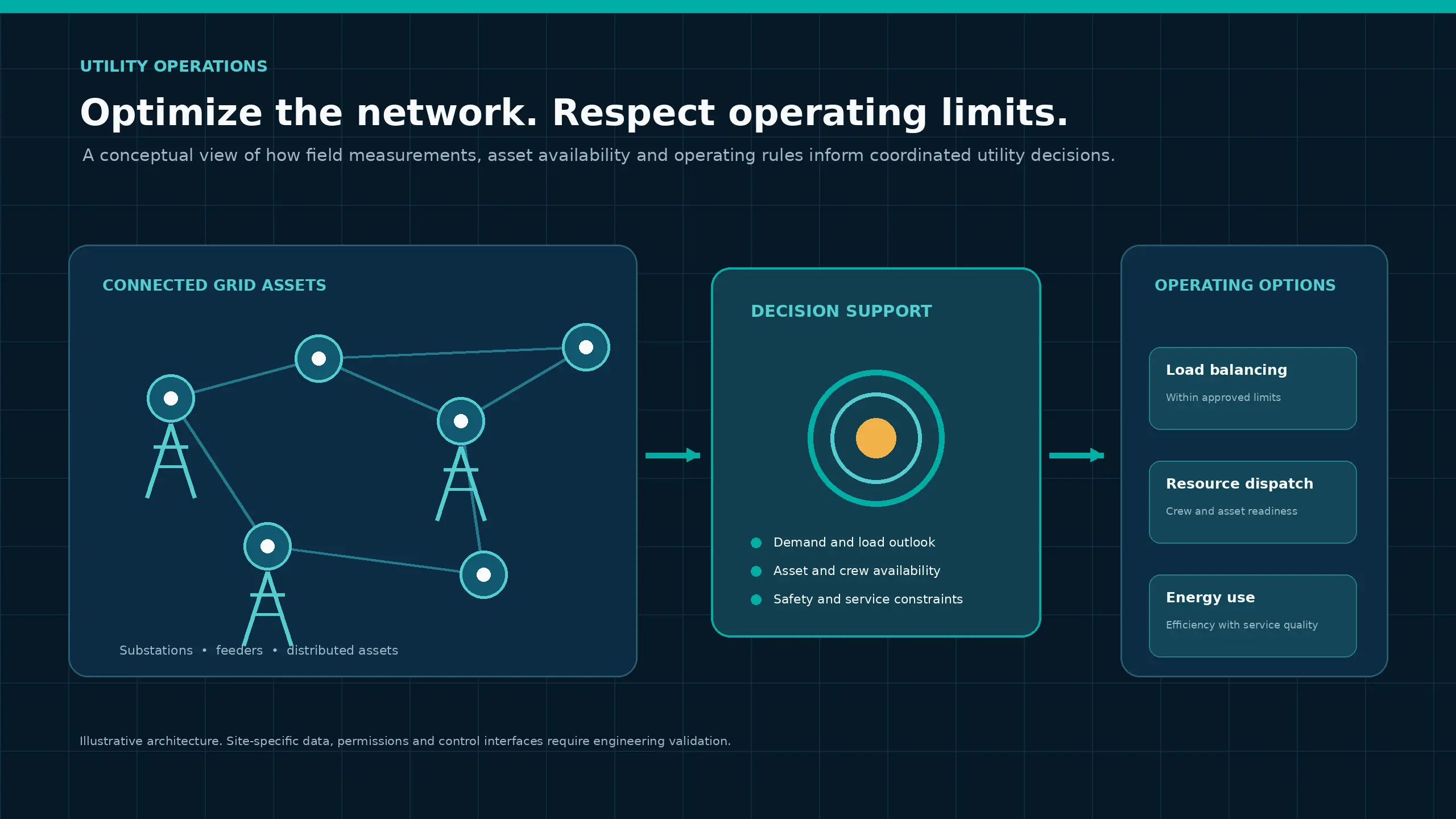
Utility network optimization requires a view of connected assets, available resources, demand outlook, and operating constraints. A decision process can bring these inputs together to compare options for load balancing, field resource dispatch, and energy use.
The appropriate operating choice depends on the actual network condition and the service requirements that must be maintained. An improvement in one metric should not come at the expense of equipment limits or service continuity.
Choose the Right Level of Operational Control
Optimization can support operations at different levels. The appropriate mode depends on the action, the equipment interface, the consequences of error, and the controls already in place.
Recommendations for Operator Review
The system presents options, supporting information, and relevant constraints. A dispatcher, control-room operator, or operations engineer evaluates the recommendation and decides whether to act through established procedures. This mode can be a practical starting point when operational data or control integration is still being assessed.
Human-Approved Commands
A proposed command is checked against configured permissions and operating conditions, then submitted for approval by an authorized person. The command is sent only after the required approval is recorded. The approval record should identify the user, decision, target equipment, command parameters, and time of authorization.
Bounded Autonomous Execution
For a narrowly defined task, an action may be executed automatically only within an engineered operating envelope. The envelope should specify eligible equipment, allowed commands, parameter limits, operating states, timeouts, and conditions that require a stop or handoff. Independent protective functions and established equipment safeguards remain in force.
AI recommendations do not replace protection relays, interlocks, safety procedures, or validated low-level control logic.
Connect Decisions to Authorized Physical Action
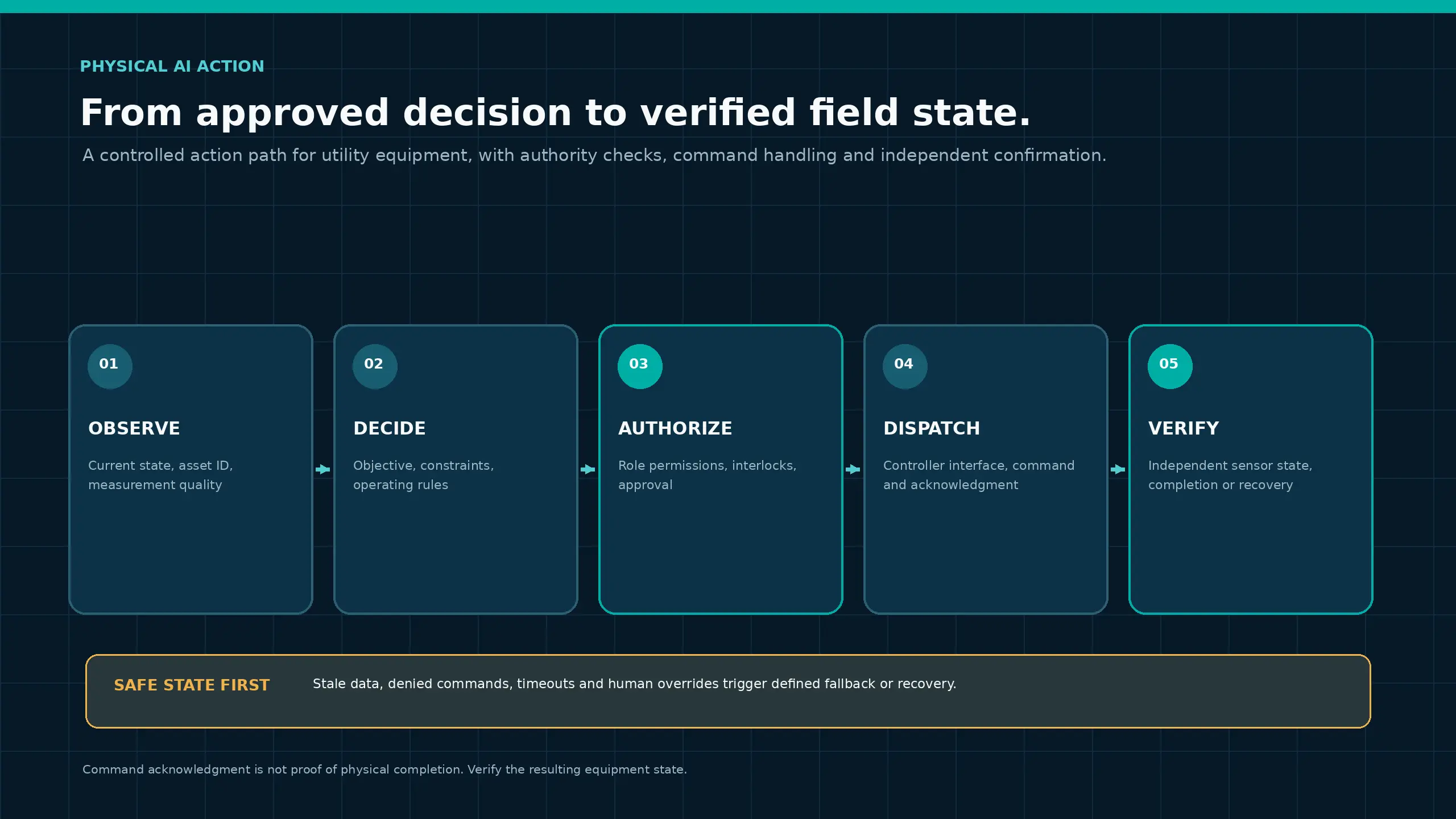
Physical execution requires more than a decision output. The action path must identify the target asset, the command interface, the authority to issue the command, and the evidence required to confirm the result.
Observe
Establish current equipment state, asset identity, measurement quality, and operating conditions.
Decide
Evaluate the objective, constraints, available evidence, and applicable operating rules.
Authorize
Check role permissions, configured limits, required approvals, and operating conditions.
Dispatch
Submit the approved command through the applicable equipment interface and record acknowledgment.
Verify
Use independent evidence to confirm the resulting physical state or initiate recovery.
Stale data, denied commands, timeouts, duplicated requests, communications failures, and human overrides require defined fallback or recovery procedures.
Verify the Physical Outcome, Not Just the Command
Depending on the site, relevant interfaces may include supervisory control and data acquisition (SCADA) systems, remote terminal units, programmable logic controllers, intelligent electronic devices, gateways, or other approved equipment interfaces. Compatibility must be assessed for the actual installation. Naming an interface does not establish that a connector is available or tested.
A controlled workflow typically checks permissions and current equipment state before dispatch. It records the command and waits for an acknowledgment or defined response. If the command is denied, delayed, duplicated, or interrupted by a communications failure, the workflow follows a documented fallback path.
Record the target equipment, requested state, command parameters, and authorization.
Capture the command response and identify rejected, delayed, or interrupted actions.
Check subsequent sensor measurements, equipment status, position feedback, or operator-confirmed field results.
Preserve the requested state, observed state, verification source, and any difference between them.
Authorized Utility Equipment Control and Outcome Verification Workflow. Command acknowledgment is not proof of physical completion.
Apply the Action Path to Utility Workflows
A useful implementation begins with a bounded workflow rather than a broad promise to automate utility operations. The selected task should have a clear owner, defined equipment boundary, available data, and a practical way to measure whether the decision improved the operation.
Coordinate Field Response
Operational context Assign available crews to service events using event priority, location, crew qualifications, access conditions, and asset information.
Decision support Present a ranked dispatch recommendation for a dispatcher to review.
Evaluation focus Test whether source records are timely and whether prioritization reflects operating policy.
Measurement Measure response times and workload consistently against an established baseline.
Support Controlled Equipment Adjustments
Operational context Assess a limited adjustment to equipment settings or operating schedules where relevant measurements, control interfaces, and engineering limits are known.
Control requirements Define the permitted range, approval mode, and independent protective functions.
Action conditions Specify conditions that cancel or reverse the proposed action.
Validation Any autonomous execution requires separate engineering validation and commissioning.
Manage Demand and Available Resources
Operational context Compare resource or load-management options against demand, asset availability, and service constraints.
Decision support Make recommendation assumptions visible and show which constraints limit available choices.
Physical action Capture the command whenever an approved action changes physical operating state.
Verification Check the resulting equipment or process condition using independent evidence.
Identify Data and System Interfaces
Integration planning should identify which systems provide read-only observations, which systems accept workflow requests, and which interfaces, if any, can accept authorized write commands. Relevant interfaces may include SCADA systems, remote terminal units, programmable logic controllers, intelligent electronic devices, and gateways.
Define Data Ownership and Quality
Data ownership, identity mapping, timestamp handling, units, event ordering, and rejected-record behavior should be agreed before a pilot. Each input needs an identifiable source, timestamp, unit, and quality status.
Select an Appropriate Deployment Model
Deployment choices may include edge processing near equipment, customer-managed servers, private hosting, or cloud services, depending on latency, connectivity, security, data governance, and site requirements.
Address Cybersecurity and Operational Safety
Use role-based permissions, authenticated command paths, traceable approvals, least-privilege access, and records that link each command to its decision and target. Define manual override and communications-loss behavior with the utility’s engineering and operations teams.
Document Recovery and Support Responsibilities
Document network dependencies, access boundaries, logging, update responsibility, outage behavior, recovery, and support ownership.
Evaluate Operational Results and Failure Behavior
A credible evaluation compares the proposed approach with a documented baseline under comparable operating conditions. The baseline may be the existing dispatch rule, operator procedure, schedule, or control policy. Define the measurement window, operating scenarios, exclusions, and success criteria before testing.
Operational Outcome
Measure the selected objective, such as response time, resource utilization, energy use, or throughput, with units and a defined time window.
Constraint Performance
Record service or equipment limit violations and any safety or quality exceptions.
Command Handling
Count rejected, timed-out, duplicated, canceled, and partially executed commands.
Independent Verification
Measure the proportion of attempted eligible actions with independently confirmed outcomes.
Recovery Performance
Assess time to return to an approved operating state after a failed action, communications interruption, or operator override.
Adverse Outcomes
Report adverse outcomes alongside improvements. Separate recommendation quality from execution quality, and distinguish a command acknowledgment from a verified physical result.
Simulation and field evidence must remain distinct.
If a study uses synthetic data, identify it as a Simulation-Based Case Study and disclose the modeled assumptions. Simulated results do not establish field performance, equipment safety, or customer savings. A customer pilot must validate the workflow with site-specific data, real operating conditions, and responsible personnel.
Define a Practical Evaluation Scope
A first assessment should select one operational question and map its full decision boundary. The scope should reflect the actual assets, available evidence, operating roles, and consequences of an incorrect recommendation or command.
UtilityGrid’s approach is based on Physical AI and AIoT concepts for connecting physical observations, AI-supported decisions, and authorized action. Specific equipment interfaces, integrations, and execution modes must be reviewed against the intended site and validated before operational use.
Select one operational question and identify the objective that needs to be evaluated.
Confirm the assets, operating area, and equipment boundary involved.
Identify responsible control-room and field personnel, source systems, and available data quality.
Assess the consequences of an incorrect recommendation or command.
Agree on the baseline, permitted operating mode, and independent verification method.
Define success criteria and conditions for stopping or escalating the workflow.
Discuss an Operational Optimization Use Case
Bring a defined utility workflow, its operational objective, and the relevant equipment or system boundary. UtilityGrid can help frame the data requirements, decision logic, control authority, integration questions, and evaluation measures for an initial assessment.