Inspection and Quality Intelligence for Utilities
Connect visual, thermal, and sensor-based inspection evidence with asset context and AI-supported assessment to help utility teams review findings and coordinate quality actions.
Discuss your inspection workflowInspection and Quality Intelligence for Utilities
Utility infrastructure inspections generate observations that must be tied to the correct asset, interpreted against operating conditions, and converted into clear follow-up. UtilityGrid examines how Physical AI and Artificial Intelligence of Things (AIoT) can support inspection and quality workflows across substations, distribution equipment, pumps, meters, and related field assets.
The appropriate approach depends on the inspection objective, available evidence, site conditions, and the decisions authorized personnel need to make.
Make utility inspections more consistent and actionable
A field inspection may identify corrosion, damaged enclosures, abnormal equipment temperatures, fluid leakage, missing components, or a reading outside an approved operating range. These findings are useful only when the inspection record identifies the asset, location, time, observed condition, and applicable acceptance criteria.
UtilityGrid’s inspection approach connects physical observations with asset context and AI-supported assessment. It is intended to help engineering and operations teams organize findings, prioritize review, and preserve a traceable record from initial observation through resolution.
It does not replace qualified inspection personnel, engineering judgment, or required safety procedures.
Focus inspection on defined utility assets and conditions
An effective inspection begins with a bounded task. For example, a utility may assess visible condition on substation transformers, circuit breakers, disconnect switches, insulators, cable terminations, or outdoor control cabinets. A separate workflow may examine pump assemblies, meter enclosures, or other network assets. Each task needs its own defect taxonomy, inspection coverage, and acceptance rules.
Visible equipment condition
Review enclosures, corrosion, insulator condition, missing components, visible damage, and other externally observable conditions.
Thermal and measurement review
Identify abnormal thermal patterns or gauge readings that may require a closer examination or additional measurement.
Defined inspection criteria
Establish defect categories, inspection coverage, acceptance rules, and escalation conditions for each asset and task.
Operating context matters. Lighting, weather, viewing angle, distance, access restrictions, asset loading, equipment state, and sensor calibration can affect what a camera or instrument captures. Inspection criteria should account for these conditions rather than treating every image or measurement as directly comparable.
Capture visual, thermal, and equipment data with context
Depending on the task, inspection evidence may include visible-light images, infrared thermography, acoustic measurements, equipment readings, and structured field notes. Visual imaging can document external condition and component presence. Thermal imaging can identify temperature patterns that warrant investigation, but interpretation depends on load, emissivity, ambient conditions, distance, and measurement technique.
Each observation should be associated with an asset identifier, timestamp, location or inspection point, operating mode where available, capture method, and data-quality status. Records should preserve the original observation alongside any derived feature or AI assessment.
Missing images, uncertain asset matches, poor image quality, stale readings, and incomplete metadata should be flagged rather than silently accepted.
Where inspection data is collected through connected devices, gateways, or edge equipment, the design must account for connectivity interruptions, time synchronization, data buffering, and secure transfer. Interfaces with asset registers, maintenance systems, and inspection-management tools should be defined and tested for the selected environment.
Utility Substation Inspection and Asset Condition Review
Field observations are associated with specific substation equipment and recorded for follow-up. Inspection quality depends on linking asset identity, captured condition, and traceable records.
Assess findings while accounting for uncertainty
AI-supported analysis can help classify inspection images, identify candidate defects, compare observations with defined criteria, or flag unusual measurement patterns for review. The model’s output should be treated as an assessment, not as an unquestionable finding.
Inspection teams need to know which defect classes were evaluated, what data was used, and when the result falls outside the conditions represented in the test set.
Evaluation should include representative examples of normal conditions and relevant defect types across equipment variants, seasons, lighting, camera positions, asset states, and field environments. Test data should be independently labeled and separated from data used to develop or tune the model. Rare or difficult defects may require targeted challenge sets, reported separately from tests that reflect expected field prevalence.
False positives can increase review workload and unnecessary site visits. False negatives can allow a defect to remain undetected. Results should therefore report false accepts and false rejects by defect class and operating condition, alongside detection performance and the rate of uncertain or escalated cases.
When image quality is inadequate or confidence is insufficient, the workflow should request another capture or qualified review.
Route findings into review, reinspection, and resolution
An inspection result should lead to a defined next step. Depending on the finding and the utility’s procedures, that may mean recording a condition for routine follow-up, assigning a qualified inspector, requesting a second measurement, scheduling a closer examination, or escalating a safety-critical concern through the organization’s established process.
- Record the observation Associate the finding with the correct asset, location, time, inspection point, and evidence.
- Review the assessment Evaluate AI-supported findings against inspection criteria and the available operating context.
- Request reinspection Arrange another capture, measurement, or qualified inspection when the evidence is incomplete or uncertain.
- Escalate when required Route safety-critical or urgent findings through the utility’s established escalation process.
- Authorize the next action Transfer approved findings into an inspection or maintenance workflow where a validated interface exists.
- Verify and close the record Record the review decision, work performed, and evidence used to confirm the condition or its resolution.
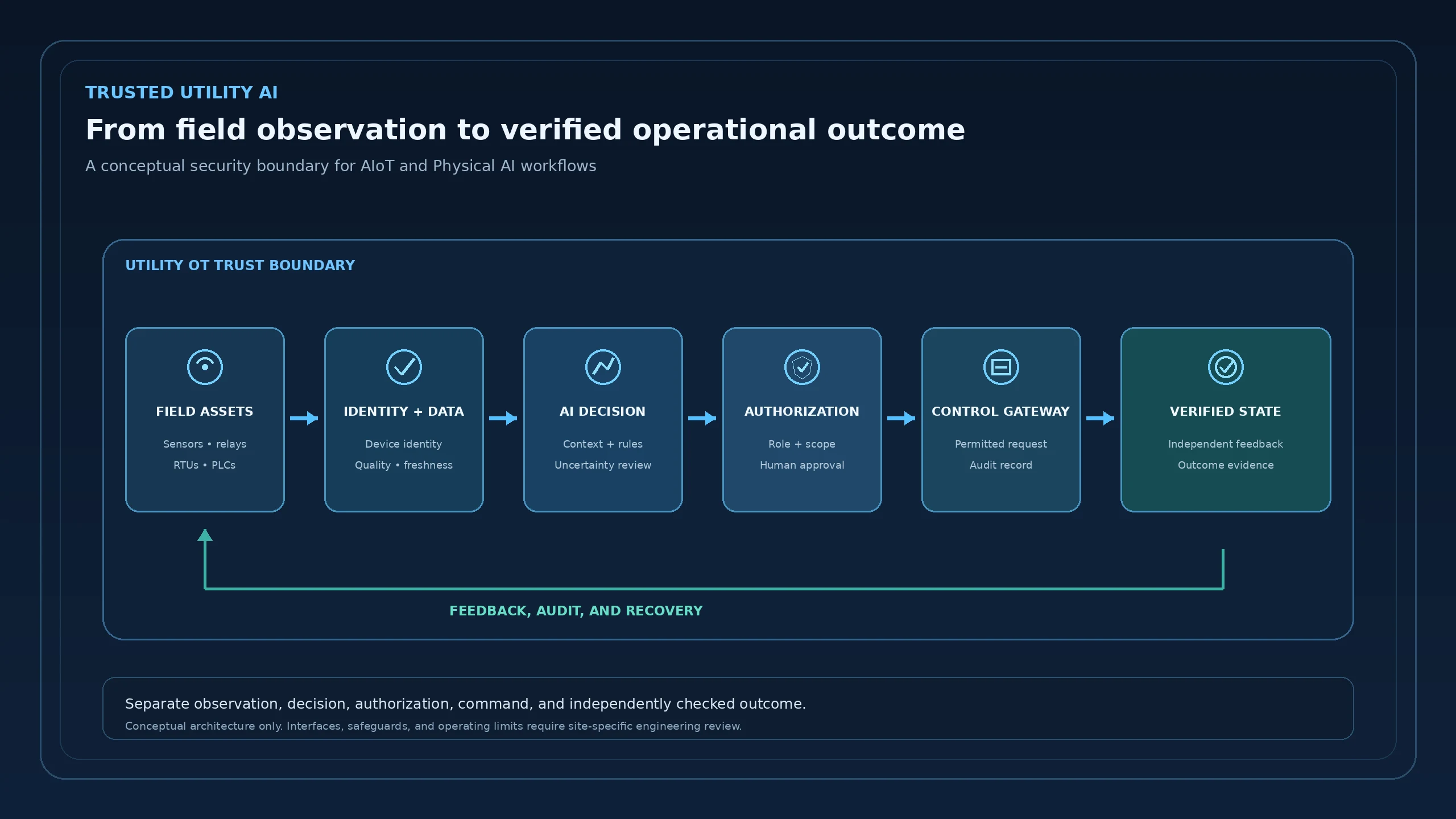
Any quarantine, isolation, switching, or equipment-control activity must remain subject to the utility’s authorization, switching rules, safety procedures, and independent protective functions. An AI recommendation or workflow request is not itself authorization to operate equipment.
Verification closes the loop. The record should capture who reviewed the finding, the decision made, any work or reinspection performed, and the evidence used to confirm the condition or its resolution. Command acknowledgment or a closed work order alone does not prove that the physical condition changed as intended.
Evaluate inspection quality with representative evidence
A pilot should begin with one defined asset class and inspection task. Establish the existing inspection method as a baseline, document the acceptance criteria, and assemble a labeled test set that reflects actual operating conditions. Include routine observations, known defects, ambiguous cases, and difficult capture conditions.
- Defect detection rate and recall by defect class.
- False-accept and false-reject rates, with clear denominators.
- Inspection time per asset and time required for secondary review.
- Share of observations that are incomplete, unusable, or assigned to the wrong asset.
- Rate of uncertain results routed to human review.
- Traceability of findings from capture through decision and verified resolution.
Compare the candidate workflow with the current process using the same asset scope and comparable conditions. Report the number and type of test cases, labeling method, equipment coverage, environmental conditions, model version, and known limitations. Synthetic imagery can support development and controlled challenge testing, but it must be identified as synthetic and cannot replace evaluation on representative real-world images before field-performance claims are made.
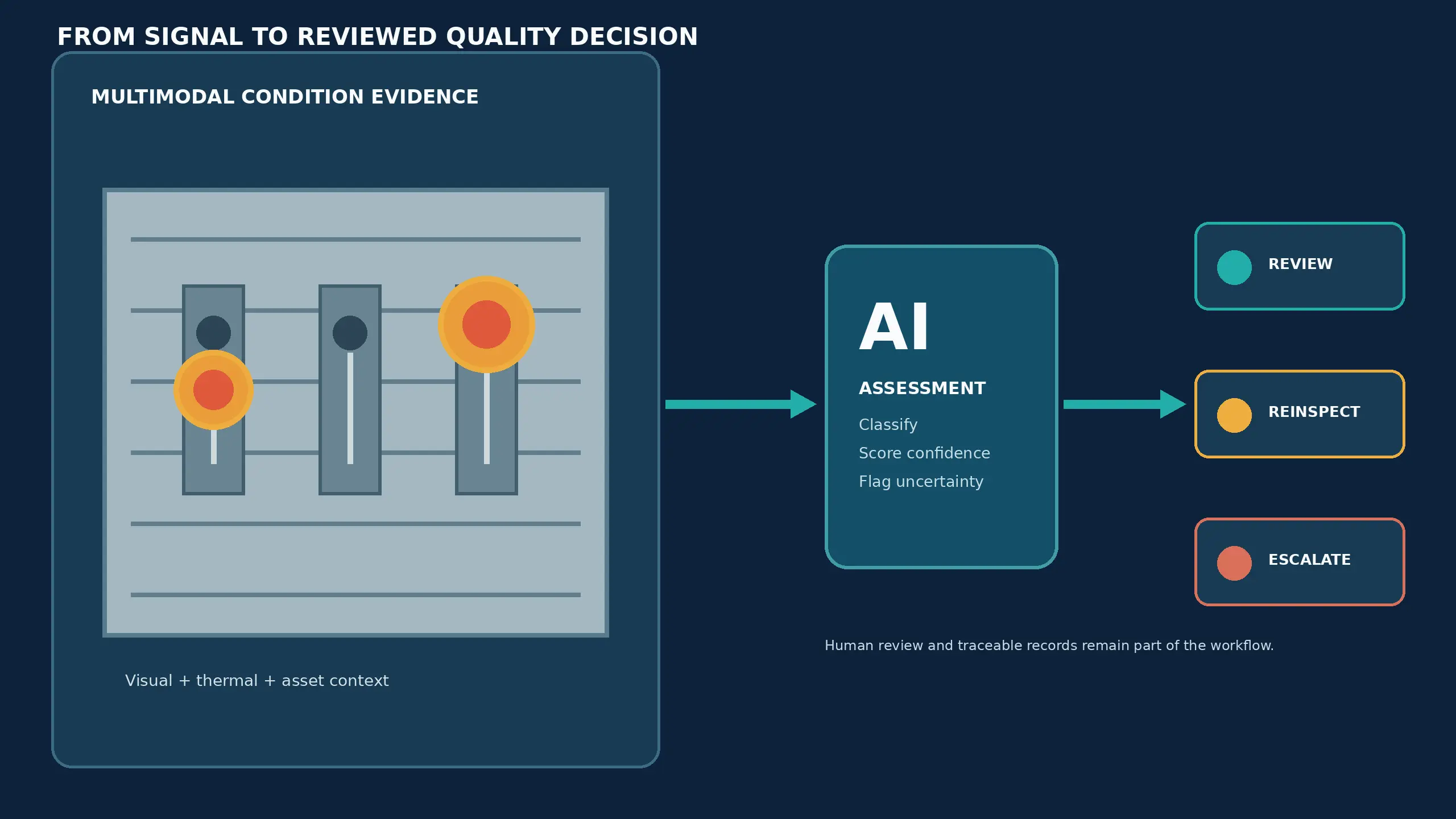
AI-Assisted Utility Equipment Defect Assessment
Visual and thermal evidence can be assessed for potential equipment defects before findings are routed for review, reinspection, or escalation. AI assessment supports prioritization, while qualified personnel retain responsibility for interpreting uncertain results and approving operational responses.
Plan the inspection workflow around utility operations
A practical implementation assessment should identify the asset register, inspection procedures, defect definitions, image and sensor sources, connectivity constraints, data retention rules, and systems that receive approved findings.
Connect inspection evidence with authorized decisions
It should also define who labels reference data, who reviews uncertain cases, who approves operational actions, and who maintains the inspection criteria as equipment and conditions change.
The scope may use edge processing, server-based analysis, or a combination, depending on image volume, latency, connectivity, cybersecurity requirements, and the utility’s deployment policies. Compatibility with a specific camera, sensor, asset-management system, or maintenance application must be confirmed through interface and site testing rather than assumed.
UtilityGrid’s Physical AI and AIoT approach provides a framework for connecting identification, sensing, AI-supported decisions, and authorized action. The precise components and integration path should be selected for the inspection task and validated before operational use.
Discuss an inspection workflow for your utility assets
Bring a defined asset class, inspection procedure, available image or sensor samples, and current acceptance criteria to an initial discussion. Together, the team can identify a suitable pilot boundary, data gaps, integration dependencies, human review requirements, and measures for comparing the proposed workflow with current practice.