
Verified AI Decisions and Physical Control Research for Utilities
Research into constrained decisions, authorized equipment actions, and independently verified physical outcomes across utility operations.
Connecting AI Decisions to Verified Utility Operations
Connecting artificial intelligence (AI)-supported decisions to utility equipment requires more than a plausible recommendation or a successful command acknowledgment. The decision must be evaluated against operating limits, authority rules, current physical state, and the evidence available after execution.
This research program examines how constrained decision methods can support utility operations while keeping control boundaries explicit and checking whether the requested action actually produced the intended physical result.
Research Focus
The research is organized around utility workflows where decisions may influence equipment, energy systems, environmental conditions, or other physical processes. Candidate work is treated as research until the method, evidence, and operating assumptions are established.
The focus is on measurable behavior under normal conditions, degraded observations, rejected commands, equipment faults, and changing permissions.
Industrial AI Agents with Restricted Equipment Interfaces
One research question is how AI agents can operate through restricted interfaces without gaining authority beyond the task they are permitted to perform. For utility environments, this can include supervisory requests associated with electrical equipment, pumps, valves, environmental systems, or other controlled assets.
The research should define the target asset, command vocabulary, operating limits, required approvals, and independent protective functions before evaluating an agent.
A useful evaluation separates the decision from the command path. The system can propose an action, check whether the current state and authority permit it, dispatch an approved command, and then use independent observations to determine whether the intended state was reached.
Stale observations, denied authority, duplicate requests, communication loss, and partial execution are deliberate test conditions rather than edge cases to remove from the evaluation.
Adaptive Supervisory Control and Constrained Optimization
Another research direction is adaptive supervisory control that changes recommendations or operating targets as demand, equipment condition, or process state changes.
For utilities, candidate problems may include load management, pumping schedules, energy subsystem operation, or other bounded optimization tasks. The research boundary should remain above validated low-level protection and control loops unless the required engineering evidence exists.
Evaluation should compare a credible fixed workflow or rules-based policy with the candidate method under matched demand and disturbance conditions. The study should measure the operational objective together with constraint violations, rejected actions, recovery behavior, and operator intervention.
A method that improves an objective while increasing unsafe or unauthorized actions should not be presented as an operational improvement.
Building and Energy Subsystem Operation
Utility-related research can also examine building and energy subsystems where demand, equipment condition, weather or environmental context, and operating schedules affect decisions.
Candidate methods may support supervisory setpoint recommendations, equipment sequencing, or bounded operating adjustments. Research questions should address how current measurements are associated with the correct equipment, how operating modes are represented, and how the system responds when observations become stale or unavailable.
The evaluation should distinguish an advisory recommendation from an authorized command and from a verified physical result. Where a control action is modeled, the study should include command rejection, delayed acknowledgment, actuator failure, and independent state checks. This keeps modeled optimization results separate from claims about safe deployment.
Environmental and Water Utility Interventions
Where relevant to a utility workflow, the program can examine environmental interventions such as water or leak response, pumping adjustments, or other bounded process-control actions.
The research question is not simply whether an algorithm detects a condition, but whether the resulting intervention is authorized, feasible, correctly executed, and confirmed through subsequent measurements.
For these workflows, evaluation can include response delay, rejected commands, duplicate actions, constraint violations, intervention effectiveness, and operator involvement. Any simulated environmental intervention should state the modeled assumptions and identify which physical relationships still require field validation.
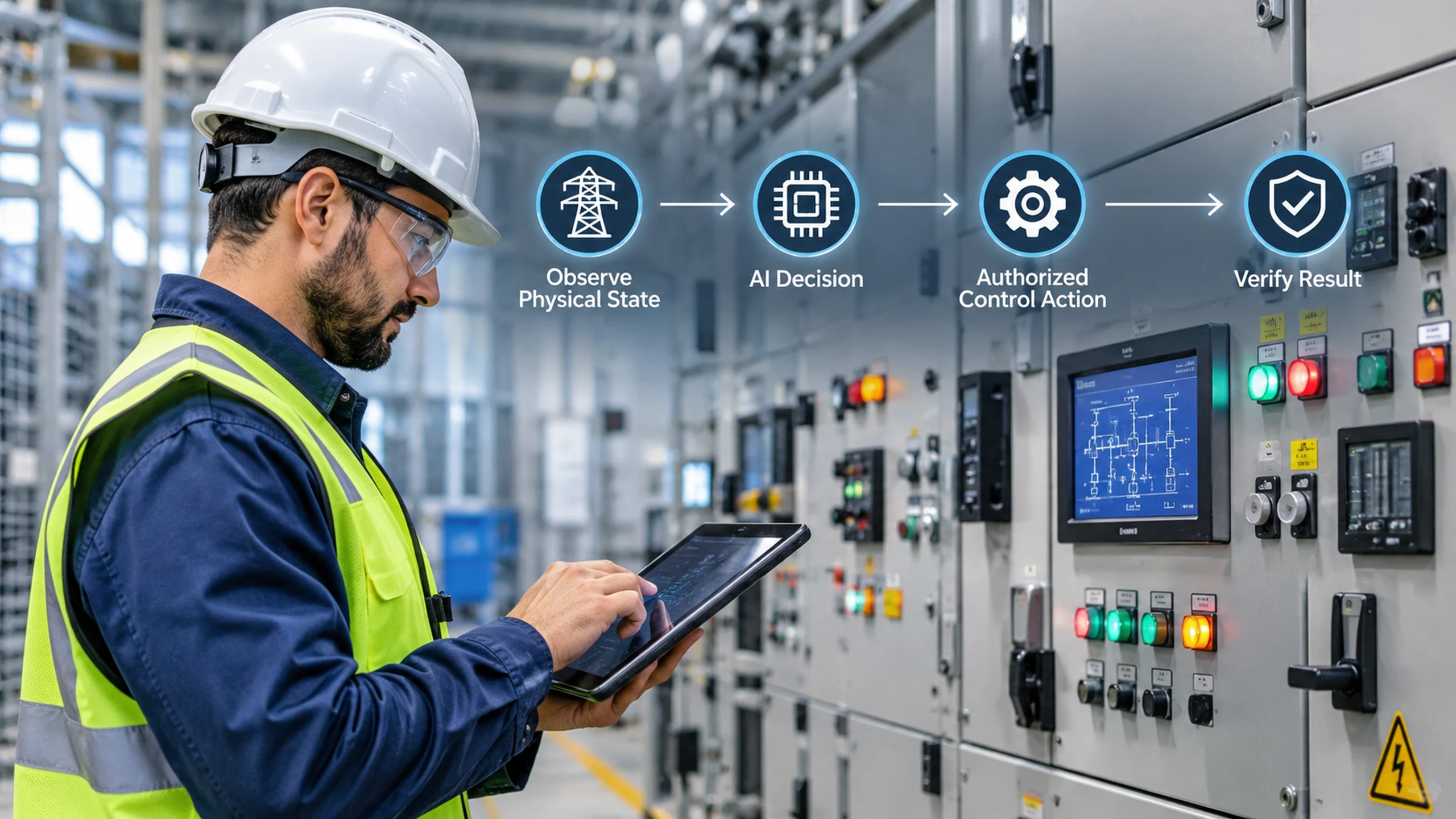
Verified Utility Equipment Control Workflow
This visual illustrates a utility control workflow that moves from observed physical state to an AI-supported decision, authorized equipment action, and independent outcome verification. The key takeaway is that command acknowledgment is not the same as verified physical execution.
Multistep Planning and Long-Horizon Operations
Longer utility tasks may require several dependent actions rather than one command. Research can examine how an agent maintains a current state estimate, checks permissions at each step, uses bounded retries, reaches defined checkpoints, and requests renewed authorization when conditions change.
A suitable demonstration should include partial task completion, actuator failure, stale observations, changed permissions, communication delays, and recovery paths. Candidate planners should be compared with fixed workflows using the same operating scenarios. The objective is to determine when adaptive planning improves task completion without increasing unauthorized actions, sequencing errors, or constraint violations.
From Observation to Verified Physical Outcome
A useful research architecture keeps model output, authorization, command dispatch, and physical verification as distinct stages. Each stage has its own evidence and failure conditions.
Acknowledgment Is Not Verification
A command response can indicate that a request was received or accepted by an interface. It does not, by itself, establish that the physical equipment reached the intended state or that the overall operational objective was achieved.
The evaluation should therefore use subsequent observations and relevant operational records to determine whether the intended result occurred. Where independent evidence is unavailable or inconclusive, the result should remain unverified rather than being treated as successful completion.
Research Demonstration and Evaluation Framework
A bounded equipment rig or simulation can provide a controlled setting for evaluating decision and control behavior before physical deployment. The model should represent the relevant equipment state, available resources, operating constraints, command interfaces, and independent outcome observations.
The demonstration should intentionally include degraded conditions so that the evaluation tests rejection and recovery behavior as well as successful execution.
Specify the operating boundary
Identify the equipment, task, permitted command vocabulary, limits, approvals, and independent protective functions.
Represent relevant state
Define equipment state, available resources, observations, command interfaces, and expected physical outcomes.
Establish a credible baseline
Compare the candidate method with an existing policy or workflow under matched operating scenarios.
Test degraded conditions
Include stale observations, denied authority, communication loss, duplicate requests, actuator faults, and partial execution.
Check physical outcomes
Use independent observations to assess whether the intended equipment state or process outcome was reached.
Document evidence and limits
Report assumptions, adverse outcomes, calculated results, operator intervention, and physical validation requirements.
Core evaluation measures
Additional measures should be selected according to the utility workflow, such as response delay, energy or resource objective, equipment-state deviation, or environmental response. The baseline should be a credible existing policy or workflow, not an artificially weak comparator. Results should distinguish calculated simulation outputs from assumptions and should report adverse outcomes as well as improvements. If the study is not executed, it should be presented as a proposed research specification rather than as a result.
What the Research Can Establish
The purpose of evaluation is to determine what can be supported by evidence, what remains uncertain, and where additional engineering review is needed.
Whether a candidate decision method can remain within defined equipment and process constraints under tested conditions.
Whether command authorization can be separated from model output and enforced through a restricted control interface.
Whether stale observations, changed permissions, failed actuators, communication loss, and partial execution are handled predictably.
Whether an action can be independently verified from subsequent physical observations rather than inferred from a command acknowledgment.
Where operator intervention, engineering review, or additional physical testing remains necessary before a deployment claim is justified.
Current Research Status
This page describes a research program adaptation and evaluation framework. It does not by itself establish a completed utility deployment, certified control system, or measured customer result.
Any future demonstration should identify its evidence type, implementation status, assumptions, test conditions, calculated results, limitations, and physical validation requirements.
Related UtilityGrid Resources
Explore related decision, action, control, and security resources for the wider UtilityGrid technology context.
Discuss Verified AI Decisions and Physical Control Research
Utility operations require clear authority boundaries, credible evaluation, and evidence that physical outcomes match intended results. A technical discussion can help identify a bounded workflow, relevant equipment, evaluation conditions, and the evidence needed before considering physical implementation.
Contact UtilityGrid →