Verification, Human Oversight, and Emerging Connectivity
Exploring how runtime assurance, independent outcome verification, operator decision support, and communication-aware operation can support more dependable Physical AI and AIoT workflows for utilities.
Why verification and oversight matter in utility operations
Utility operations depend on information arriving at the right time, from the right asset, with enough context to support a safe decision. A substation measurement may be delayed, a remote pump station may temporarily lose its backhaul connection, or a field device may report a state that conflicts with an independent indication. When artificial intelligence (AI) supports monitoring or recommends an operational response, the system must recognize these conditions rather than treat every observation as current and complete.
UtilityGrid examines these questions through Physical AI and Artificial Intelligence of Things (AIoT). The research focus is not simply whether a model produces a plausible recommendation. It is whether the surrounding system can identify uncertainty, preserve operator authority, enforce defined limits, and establish what happened after an approved action.
This work is relevant to electric transmission and distribution facilities, substations, distributed energy resources, remote pumping and water infrastructure where applicable, and other geographically dispersed utility assets. The exact asset class and process boundary must be selected for each study. A method suitable for supervisory monitoring at a substation should not be assumed suitable for protection functions or direct equipment control.
Runtime assurance and independent outcome verification
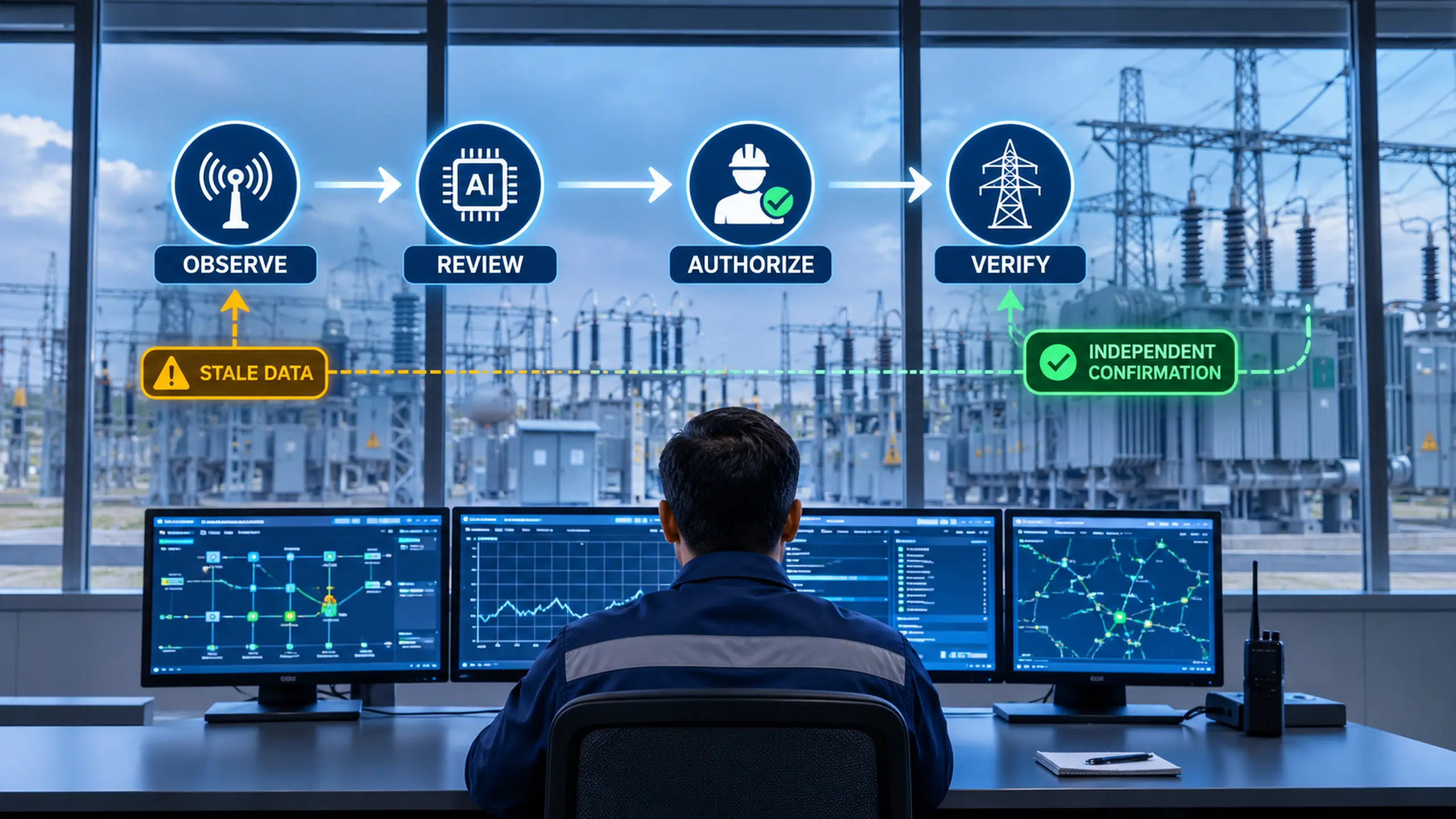
Runtime assurance evaluates system behavior while an application is operating. A monitoring layer can check whether incoming measurements are fresh, whether the operating mode is known, whether a proposed command falls within an approved envelope, and whether required authorization is present. If a required condition is not met, the workflow can withhold the command, request a new observation, or escalate the case to a qualified operator.
For a utility workflow, the assurance boundary should identify the asset, the decision being supported, the data sources, the command interface if one exists, and the independent evidence used to confirm the resulting physical state. A command acknowledgment confirms that a message was received by an interface; it does not, by itself, establish that a breaker, pump, valve, or other asset reached the requested state. Where physical action is in scope, verification should use an appropriate independent indication, such as a separately acquired position, status, or process measurement.
Candidate research questions include: Which operating properties must always hold? How should the system respond when an observation is stale or contradictory? Which conditions require operator approval? What evidence is sufficient to distinguish a completed action from a rejected, delayed, partial, or failed action? The answers should be specific to the equipment, operating procedures, and authority model under review.
A received command message is not proof of a physical outcome. Where physical action is in scope, the result should be checked against suitable independent evidence.

Utility Control Room Runtime Assurance and Human Oversight
The visual presents an operator-centered assurance sequence for utility control room workflows. It emphasizes that observations and recommendations should be reviewed before an authorized response, and that completion requires independent confirmation rather than a command acknowledgment alone.
Bounded formal verification and AI interface assurance
Formal verification can be useful when a system property can be stated precisely and represented in a tractable model. For example, a bounded analysis may examine whether a command sequence can exceed a specified operating limit, bypass an authorization check, or repeat an action after a timeout. The result applies only to the modeled properties, interfaces, assumptions, and state space. It does not establish that the complete physical installation is safe, certified, or free of defects.
Foundation-model interfaces require additional boundaries. A language model or agent may help interpret an operator request or prepare a recommendation, but natural-language output should not be treated as equipment authority. A controlled interface should convert an accepted request into a structured proposal, validate the target and permitted operation, check current state and permissions, and require the defined approval path. The model should be able to abstain or escalate when the request is ambiguous, the evidence is incomplete, or the operating condition is outside the evaluated scope.
Any formal-verification claim should name the property checked, the model and abstraction used, assumptions about inputs and timing, the verification method, and unresolved gaps. Tests of a software model or interface should be kept distinct from hardware-in-the-loop tests, supervised site trials, and operational evidence.
Explicit operating properties
Define the limits, authorization conditions, timing constraints, and state-transition rules that a bounded model is intended to examine.
Structured AI interfaces
Treat model output as a proposal that must pass target, permission, operating-state, and approval checks before any permitted action proceeds.
Abstention and escalation
Preserve the ability to withhold a recommendation or escalate when a request is ambiguous, evidence is incomplete, or conditions exceed the evaluated scope.
Evidence matched to the claim
Distinguish software-model analysis from interface testing, hardware-in-the-loop work, supervised site trials, and operational evidence.
Human factors, explanations, and operator decision support
Human oversight is effective only when the operator has enough time and relevant information to make a decision. Research should examine how alerts are prioritized, how uncertainty is presented, what supporting measurements are visible, and whether an operator can understand why a recommendation was produced. An explanation should identify the material evidence and limitations behind a recommendation; it should not imply that a model’s stated rationale is a proven causal account.
The study design should account for control room roles, field technicians, dispatch or maintenance personnel, escalation paths, shift handovers, alarm load, and the time available for intervention. It should also test misleading recommendations, conflicting sensor readings, repeated alerts, and cases in which the safest response is to take no automated action.
Evaluation can include intervention latency, operator workload, correct escalation, missed intervention opportunities, override frequency, and the quality of decision records. Measures should be defined with units, denominators, time windows, and a credible baseline. A lower alert count is not necessarily an improvement if important events are missed.
Understandable evidence
Present the relevant measurements, data quality, uncertainty, and limitations supporting a recommendation.
Clear authority and escalation
Examine role boundaries, approval paths, field-to-control-room coordination, and shift handover requirements.
Realistic intervention conditions
Test delayed responses, misleading recommendations, conflicting readings, repeated alerts, and situations requiring no automated action.
Meaningful workload measures
Define intervention time, workload, override frequency, escalation quality, and missed intervention opportunities against a credible baseline.
Communication-aware sensing and control
Connectivity quality affects how utility systems should interpret remote observations. Wireless sensing and integrated sensing and communication may provide additional ways to observe distributed assets, but the useful performance depends on coverage, interference, device placement, power availability, message timing, and the service characteristics of the selected network.
A communication-aware workflow should consider both link quality and measurement age. A recent measurement delivered over a reliable link may support a different decision from an old measurement that arrives after an outage. The system should preserve event time and receive time, identify missing or reordered messages, and avoid treating delayed data as a current state without an explicit validity check.
For remote substations, distributed energy sites, pipelines, and isolated utility facilities, a hybrid terrestrial and non-terrestrial communications design may be worth evaluating where terrestrial coverage is limited. Satellite or other non-terrestrial connectivity can provide a path for selected telemetry or coordination functions, but latency, availability, bandwidth, cost, weather exposure, and service dependencies must be assessed for the actual application. Local protection and equipment-level safeguards must remain effective when external communications are unavailable. Loss of a wide-area link must not silently expand the authority of an autonomous system.
Measurement age
Preserve event timestamps and receive timestamps so the application can distinguish current observations from delayed information.
Link quality and message integrity
Consider coverage, interference, missing messages, duplicates, reordered events, and the service characteristics of the selected network.
Hybrid connectivity options
Evaluate terrestrial and non-terrestrial paths for selected telemetry or coordination functions where site conditions justify the assessment.
Degraded-operation safeguards
Preserve local protection and equipment-level safeguards during external communications outages. Connectivity loss must not expand autonomous authority.
Utility Field Operations Resilient Connectivity and Remote Asset Oversight
The visual depicts field personnel reviewing remote utility asset information in an outdoor operating environment. It supports discussion of resilient telemetry, field-to-control-room coordination, and human review when a remote asset is difficult to reach or its communications path is degraded.
Proposed controlled demonstration
A practical demonstration can use a bounded utility scenario represented in a controlled simulation or test environment. A suitable starting point is remote monitoring and a narrowly defined supervisory request for a substation auxiliary system or a remote pump station. The selected equipment, state variables, operating limits, command path, and human authority must be specified before testing. The demonstration should not connect to live protection or control equipment unless a separate engineering and safety approval process authorizes that work.
Inject delayed, dropped, duplicated, and reordered messages; uncertain or conflicting observations; a misleading AI recommendation; a delayed human response; a denied permission; and a communications outage followed by recovery. Compare a baseline policy, such as fixed freshness thresholds and established operator escalation, with the candidate oversight and fallback policy. Keep hidden scenario truth separate from the data available to the decision method so the method cannot use information that would not exist in operation.
Record observation timestamps, receive timestamps, asset identity, link-quality indicators, data-quality flags, model and policy versions, recommendation records, approval decisions, command identifiers, acknowledgments, operator interventions, and independently observed outcomes. Use synthetic asset identifiers in public examples. If the work uses synthetic data, label the study as a simulation and do not present it as a customer deployment or field result.
Capture asset identity, measurements, event time, receive time, and communication quality.
Evaluate data freshness, operating conditions, permissions, and the proposed supervisory response.
Apply the defined approval path, operator review, and fallback policy before an eligible action.
Check the resulting state using specified independent evidence and preserve the decision record.
Evaluation measures
Measures should be defined before testing, with clear event boundaries, units, denominators, and operating assumptions. Report adverse cases as well as successful ones.
Detection coverage
Communication or observation failure cases correctly identified divided by the defined failure cases.
Intervention latency
Elapsed time from a defined trigger to the required human or automated intervention, with start and end events stated.
Stale-command rejection
Commands rejected because their supporting state exceeded the approved age limit, reported against all commands requiring freshness checks.
Operator workload
Review time, intervention count, alert burden, and task completion under the specified scenario and staffing assumptions.
Retained functions
Required monitoring or local functions that remain available during a communication failure, with each function defined in advance.
Recovery
Time and steps required to restore data flow and resume the approved workflow, including reconciliation of delayed or reordered events.
Independent outcome verification
Eligible actions for which the physical result is confirmed by the specified independent evidence, divided by attempted eligible actions.
Include false alarms, missed failures, rejected commands, partial completion, unnecessary escalation, and cases where recovery does not meet the stated criteria. State the number of runs or test cases, operating assumptions, model boundaries, and uncertainty. Do not describe a test range as a confidence interval unless it was calculated using an appropriate statistical method.
Limitations and assurance boundaries
A simulated communication outage does not reproduce every radio-frequency, terrain, weather, electromagnetic, or carrier-network condition at a real utility site. A model of operator behavior does not establish workload or intervention performance for a specific control room. Formal verification of a bounded software model does not prove the correctness of field sensors, wiring, controllers, equipment protection, or operating procedures.
Wireless sensing, integrated sensing and communication, and hybrid terrestrial/non-terrestrial connectivity should remain candidate approaches until a site-specific assessment confirms their suitability. Protocol names and network types are implementation options, not claims of existing UtilityGrid compatibility. Cybersecurity, privacy, safety engineering, and regulatory requirements need separate review.
Simulation boundaries
Simulated outages cannot reproduce every field condition, including radio-frequency behavior, terrain, weather, electromagnetic effects, or carrier-network performance.
Human-performance boundaries
A model of operator behavior does not establish workload or intervention performance for a particular control room.
Formal-method boundaries
Verification of a bounded software model does not prove correctness of the complete physical installation or operating procedures.
Site-specific review
Connectivity options require assessment against actual site conditions. Cybersecurity, privacy, safety engineering, and regulatory requirements need separate review.
Research status and evidence
Research adaptation and proposed evaluation scope
This page describes a UtilityGrid research adaptation and proposed evaluation scope. It does not claim that UtilityGrid has completed the described experiments, validated a specific connectivity stack, achieved a measured intervention time, or deployed autonomous control at a customer facility.
The shared research initiative is associated with Aperture Venture Studio, GAO RFID Inc., and GAO Tek Inc. Shared research activity should be distinguished from UtilityGrid-specific staffing, implementation, demonstrations, and customer results.
The central Aperture program reference currently identifies this topic as a shared research program and describes runtime monitoring, human intervention, operator workload, communication-aware behavior, and degraded-operation recovery as priorities. It also states that its page has not yet been updated. UtilityGrid-specific claims, team assignments, experiments, and results therefore require separate confirmation before publication.
Related research and implementation resources
Explore related UtilityGrid technologies and research programs for additional context on physical actions, integration, safeguards, and verified operational outcomes.
The research hub should provide access to all published programs through a shared program directory. Link only to destinations that are live and reviewed. Use the selected action or monitoring application as the context for a detailed study rather than repeating the full content of related engine and technology pages.
Evaluate verification, oversight, and connectivity at your utility facility
Discuss how to evaluate verification, operator oversight, and communication resilience at your utility facility. A useful assessment begins with the asset class, operating workflow, available measurements, communications dependencies, approval roles, and the evidence required to confirm a successful outcome.
Discuss a Utility Research Assessment