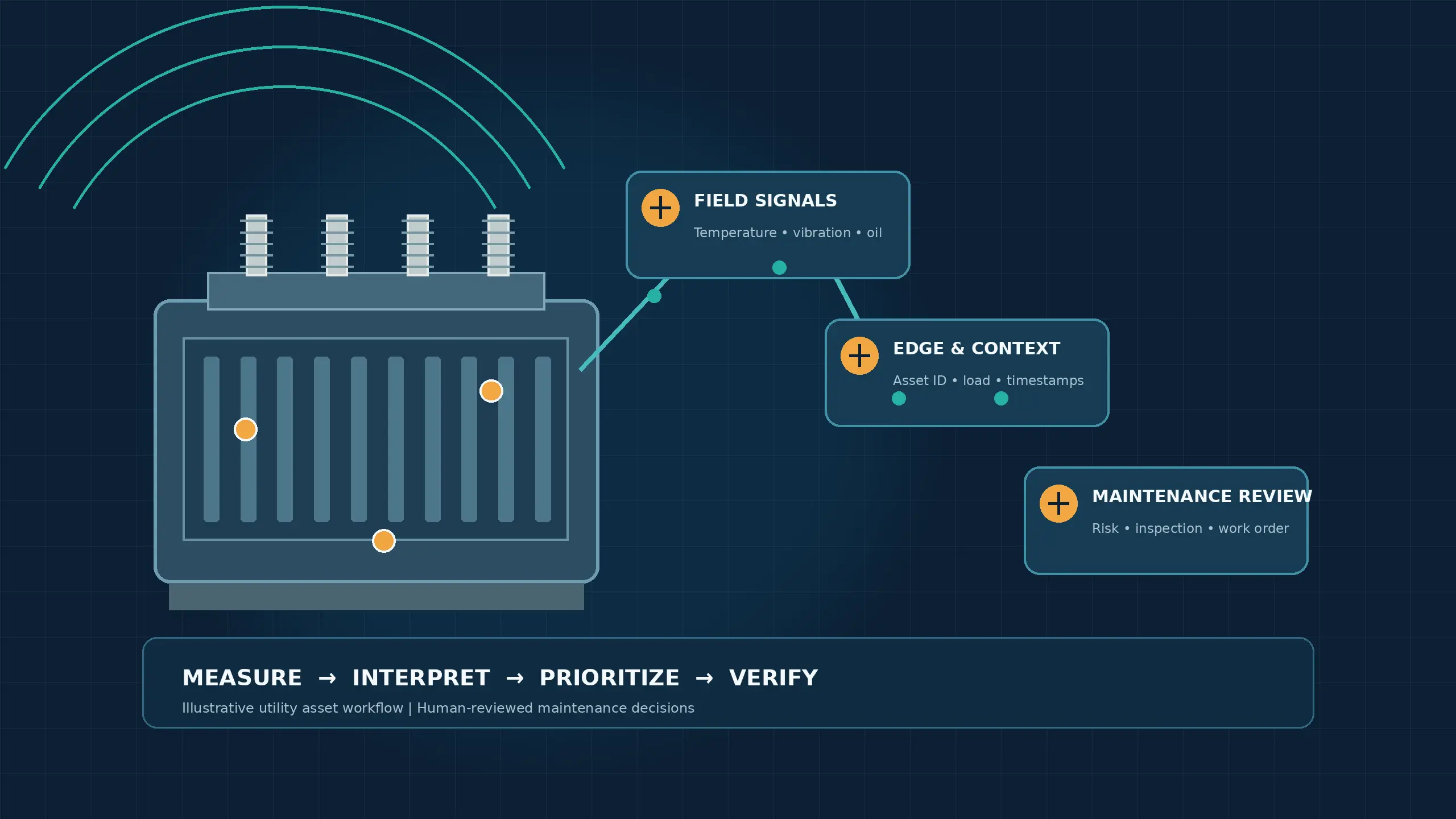
Predictive Maintenance for Electric Utilities
Use equipment condition and operating history to help maintenance teams identify developing risks, prioritize inspections, and plan work with better context.
Discuss your applicationPredictive Maintenance for Electric Utilities
Predictive maintenance uses equipment condition and operating information to support maintenance decisions before an issue becomes an unplanned outage. For electric utilities, the approach can help teams assess the health of power transformers, circuit breakers, switchgear, substation batteries, and auxiliary equipment.
Its value depends on the quality of the available evidence, the operating context of each asset, and the maintenance actions a team can realistically take.
Turn equipment data into maintenance priorities
A useful predictive maintenance workflow connects field measurements with asset identity, operating conditions, inspection findings, and maintenance history. A temperature change, vibration pattern, electrical measurement, or oil-condition result means more when it is interpreted alongside load, ambient conditions, switching activity, and the asset’s service history.
Depending on the equipment and failure mechanisms under review, relevant inputs may include:
- Condition measurements such as temperature, vibration, pressure, electrical characteristics, dissolved-gas or oil-quality results, and partial-discharge observations where applicable.
- Operating context, including load, switching operations, duty cycles, ambient conditions, and equipment operating mode.
- Inspection records, test results, alarm history, maintenance logs, work orders, and documented failure events.
- Asset identifiers, timestamps, measurement units, sensor health indicators, and data-quality flags.
Not every asset requires the same sensors or sampling plan. Instrument selection, placement, measurement intervals, and alarm limits should reflect the equipment design, the failure modes being assessed, and the utility’s maintenance practices.
Match the analytical method to the available evidence
Predictive maintenance can involve several different analytical tasks. They should be described separately because each requires different data and supports a different maintenance decision.
Anomaly detection
Identifies readings or behavior that differ from an established operating baseline. An anomaly is a reason to investigate, not proof that a component is failing.
Failure-risk estimation
Estimates the likelihood or relative risk of a defined failure event over a stated period. Credible estimates require relevant failure records, consistent event definitions, and representative operating history.
Remaining-life prediction
Estimates the time or usage remaining before a defined end point. This requires sufficient degradation history and a defensible relationship between observed condition and the end point. It should not be claimed when the available evidence supports only anomaly detection.
Models should be evaluated against a credible baseline, such as existing thresholds, condition-based rules, or the utility’s current inspection and maintenance process. Evaluation should include uncertainty, false alarms, missed faults, and changes in performance across asset types and operating conditions.
Connect alerts to the maintenance workflow
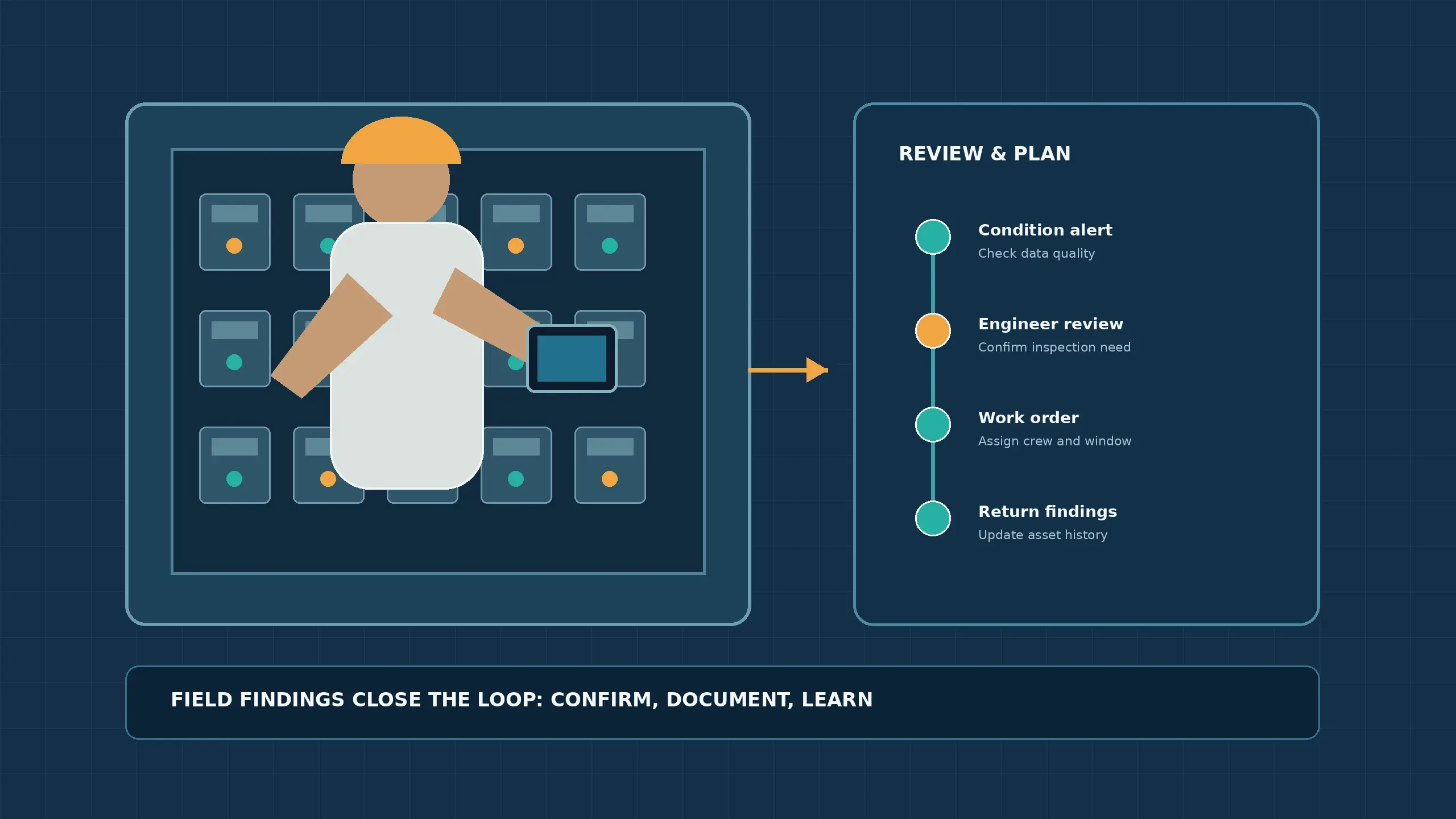
An analytical output becomes operationally useful only when it reaches the people responsible for assessing and acting on it. A practical workflow can move through these steps:
- Associate the observation Connect each observation with the correct asset, event time, operating mode, and measurement unit.
- Check data quality Check sensor health, missing data, timestamp alignment, and other quality conditions before interpreting a change.
- Route for review Route a flagged condition or risk estimate to the responsible reliability engineer or maintenance planner.
- Prioritize inspection Consider asset criticality, evidence strength, operating constraints, and available crew resources.
- Authorize maintenance work Create or update a work order through the utility’s approved maintenance process when a person authorizes the next step.
- Record outcomes Record inspection findings, corrective work, and subsequent equipment behavior so the asset history can inform future analysis.
Human review remains important, particularly when evidence is incomplete, operating conditions differ from those used in model evaluation, or a recommended intervention could affect system reliability. A maintenance recommendation is not an equipment-control command. Any physical action must follow the utility’s established authority, safety procedures, and control boundaries.
Substation Asset Condition Intelligence for Predictive Maintenance
Field technicians review substation equipment and condition information. Their observations can contribute to asset assessment, inspection prioritization, and maintenance planning.
Check data readiness before selecting a pilot
A predictive maintenance pilot should begin with a specific asset class and a clearly defined maintenance question. Before choosing a model, review whether the organization has enough consistent evidence to test that question.
Failure history Confirm that failure events have reliable dates, asset associations, failure-mode descriptions, and repair outcomes.
Maintenance labels Determine whether inspection findings, work orders, and corrective actions distinguish confirmed faults from routine service.
Condition coverage Check sensor availability, measurement continuity, calibration status, operating-mode context, and known data gaps.
Asset variation Identify differences in equipment models, age, duty, site conditions, and maintenance practices that may affect transfer between assets.
Integration Establish how asset records, operational measurements, alarms, and maintenance systems will be associated and exchanged.
If failure history or maintenance labels are sparse, begin with a narrower anomaly-detection or condition-review objective. Do not present anomaly scores as validated failure probabilities or remaining-life estimates. Where synthetic data is used to test a method, label the work as a simulation and keep simulated warning time separate from production performance.
Evaluate operational usefulness, not just model output
Compare the proposed approach with the existing maintenance process under representative operating conditions. Agree on the baseline, test period, asset population, event definitions, and acceptance criteria before reviewing results.
| Evaluation measure | What to assess |
|---|---|
| Useful warning time | The interval between a valid warning and a confirmed fault or maintenance-relevant condition, when the available records support that calculation. |
| False-alarm rate | The number of alerts that do not lead to a confirmed maintenance finding, normalized to a stated asset or operating-time denominator. |
| Fault recall | The share of confirmed fault episodes detected by the method, with exclusions and event grouping documented. |
| Inspection findings | The proportion of reviewed alerts that lead to a relevant, confirmed condition or useful diagnostic result. |
| Maintenance effort | Time spent reviewing alerts, conducting inspections, resolving data issues, and completing follow-up work. |
| Missed events and adverse cases | Faults not detected, alerts delivered too late, and cases where the method performs worse than the baseline. |
Earlier detection does not automatically mean avoided downtime or lower cost. Any estimate of operational or financial benefit must account for whether a crew, spare part, outage window, and effective intervention were available in time. Report measured detection performance separately from modeled operational or economic effects.
Architecture and integration considerations
Connected intelligence with defined operating boundaries
The UtilityGrid AIoT Engine™ provides the named architecture for connecting identification and sensing information with analysis and decision support. The UtilityGrid Physical AI Engine™ extends that architecture to authorized physical action where a defined equipment interface, authority model, operating limits, and independent outcome checks are appropriate.
The engines describe an architectural approach; the specific devices, interfaces, integrations, and deployment arrangements for a utility must be assessed and validated.
Integration planning should identify the relevant asset-management, supervisory control, historian, and computerized maintenance management records; define asset identifiers and time handling; and specify read-only or write permissions. Compatibility with a particular sensor, controller, protocol, or enterprise system should be confirmed through technical review rather than assumed.
Discuss a predictive maintenance use case
Start with one equipment class, one maintenance decision, and the evidence available to support it. UtilityGrid can use that discussion to help define the operational boundary, data requirements, integration dependencies, baseline workflow, and pilot measures.
Electric Utility Maintenance Review and Work-Order Feedback
Engineering and maintenance personnel review equipment information and analytical findings to support inspection decisions, maintenance planning, and follow-up.