
Physical AI and AIoT Questions for Utilities
Find answers to common questions about connected utility systems, data, integration, deployment, pilot requirements, and the role of human oversight.
Explore the FAQs →Clear answers for practical utility decisions
Physical AI and AIoT connect physical-world observations with AI-supported analysis and operational workflows. For utilities, the important questions go beyond the model: teams need to understand asset identity, data quality, integration boundaries, authority, operating limits, and how results will be verified.
This guide addresses common questions about where these approaches may fit, what they require, and how to evaluate them responsibly.
What is Physical AI in utility operations?
Physical AI applies artificial intelligence (AI) to situations where software must interpret physical-world conditions and support a decision or action. In utilities, that can involve network assets, transformers, switchgear, meters, pumps, environmental measurements, inspection records, and other equipment or infrastructure. A typical workflow connects identification and sensing with AI-supported decisions, followed by a reviewed operational response where appropriate.
The important distinction is that a useful system must account for the physical operating context. A model that identifies an abnormal measurement is only one part of the workflow. The organization also needs to know which asset produced the observation, whether the measurement is trustworthy, who reviews the result, what action is permitted, and how the outcome will be verified.
How is AIoT different from conventional IoT in utilities?
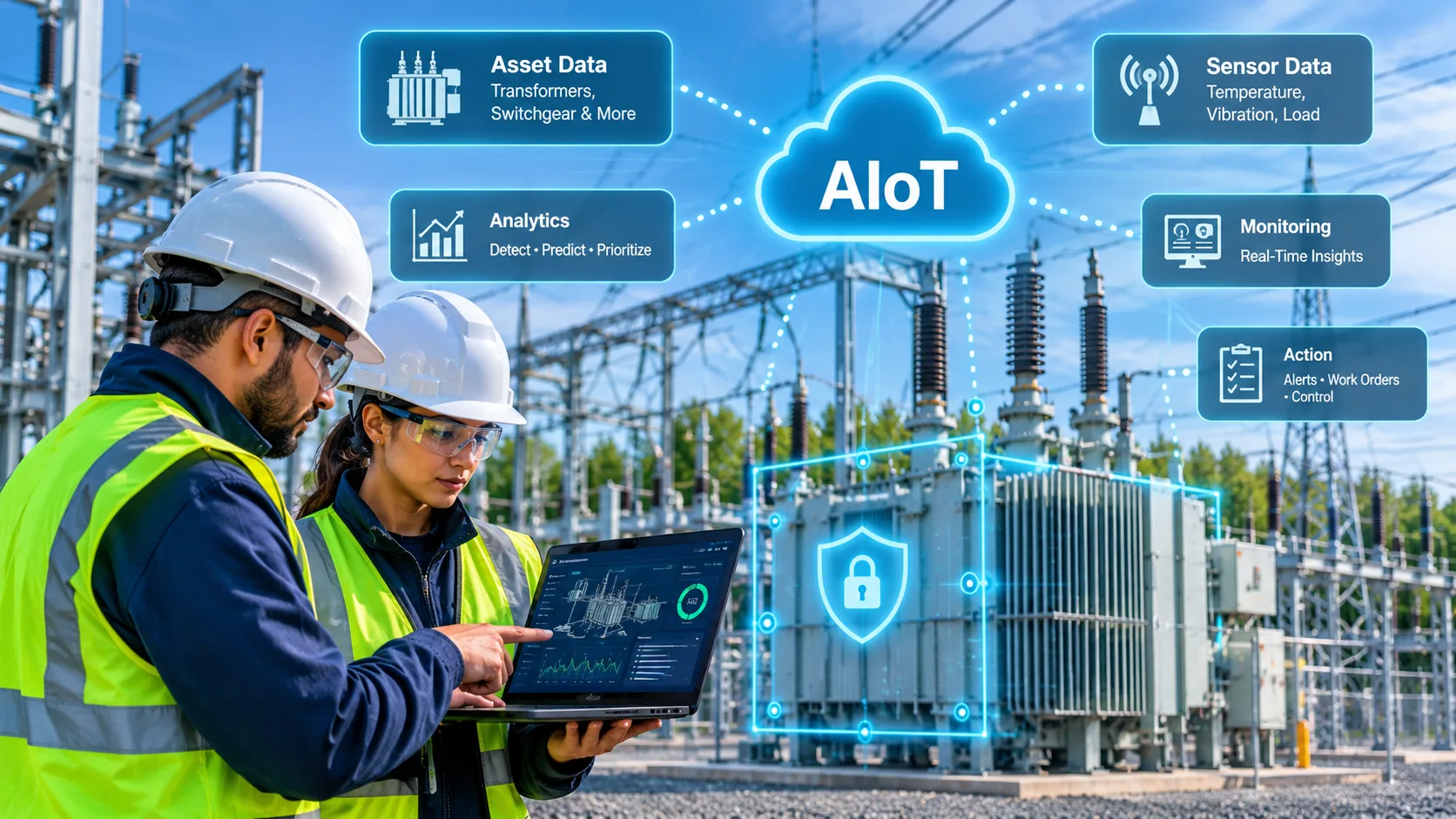
The Internet of Things (IoT) primarily connects devices, captures observations, and moves operational data between field equipment and software systems. AIoT adds AI-supported analysis and decision functions to that connected environment. In a utility setting, this may mean combining asset identity, sensor readings, operating history, and contextual information to prioritize an inspection, flag a condition, or recommend a maintenance response.
AIoT does not automatically mean autonomous control. The output may remain a dashboard finding, alert, recommendation, or workflow request. When a decision can affect equipment, the system also needs defined authority, operating limits, approval rules, and evidence that the resulting physical state matches what was intended.
Which utility assets and workflows are good candidates?
Good candidates have a defined operational question, observable conditions, a responsible user, and a measurable response. Examples include transformer and switchgear condition monitoring, meter and network-asset data quality, field inspection prioritization, equipment anomaly detection, maintenance planning, and selected infrastructure or pump monitoring workflows.
The strongest candidates are usually bounded workflows rather than broad attempts to automate an entire operation. For example, a pilot might ask whether sensor and maintenance data can help a utility team prioritize transformer inspections. The evaluation can then measure detection quality, review workload, false alerts, and the time required to complete the follow-up task.
What data and equipment are needed?
The required data depends on the operational question. Common inputs include asset identifiers, timestamps, equipment state, sensor measurements, maintenance records, inspection findings, operating mode, and quality flags. Relevant field equipment may include sensors, meters, cameras, RFID or other identification devices, gateways, edge computers, and existing utility monitoring equipment.
Data quality matters as much as data volume. A utility team should understand sampling intervals, calibration assumptions, missing readings, duplicate events, delayed messages, time synchronization, asset association, and sensor health before using the data for an AI decision.
For a practical starting point, see the guidance on selecting sensors and RFID, BLE, and UWB comparison.

Can Physical AI and AIoT work with existing utility systems?
They can be designed around existing systems, but the integration boundary must be defined before a deployment decision is made. Relevant systems may include supervisory control and data acquisition (SCADA), enterprise asset management, computerized maintenance management systems (CMMS), outage or work-management applications, meter data systems, historians, and other operational databases.
Integration work should define identifiers, timestamps, units, event mapping, synchronization, rejected records, access permissions, and recovery behavior. A proposed interface should not be described as a tested connector unless testing records support that claim. For deeper implementation guidance, see system integration and deployment and integrating Physical AI and AIoT with industry systems.
Should processing run at the edge, on a local server, or in the cloud?
There is no universal deployment location. The choice depends on response time, connectivity, data handling, maintenance responsibility, integration requirements, and the consequences of losing communications. Field-edge processing can support functions that need local responsiveness or continued operation during a network outage. An on-site server may centralize processing within a facility, while cloud services can support centralized analytics and broader data management when connectivity and organizational requirements permit.
A hybrid design is often evaluated by assigning each function to the location that best fits its requirements. The important question is not simply where the software runs, but what continues, buffers, degrades, or stops when connectivity is unavailable. See edge, cloud, and server deployment guidance for the decision factors.
Does Physical AI automatically control utility equipment?
No. A recommendation, workflow request, approved command, and direct equipment control are different levels of system involvement. A utility application can stop at decision support, or it can connect an approved decision to a bounded physical action when the required interfaces, permissions, protective functions, and verification mechanisms are in place.
Any physical action should define the target, objective, operating limits, authority, command interface, fallback behavior, and independent confirmation of the resulting state. Command acknowledgment alone does not prove that the intended physical outcome occurred. For related safeguards, see cybersecurity and physical action safeguards.
What happens if a sensor, network connection, or data source fails?
A credible design should define degraded behavior before a pilot begins. Examples include stale observations, missing measurements, duplicate events, delayed messages, incorrect asset associations, communications loss, or sensor faults. Depending on the workflow, the system may buffer data, mark an observation as unusable, escalate for human review, continue a limited local function, or stop a decision path.
The correct response depends on the operational consequences. A monitoring dashboard may tolerate delayed data differently from a workflow that proposes a physical equipment adjustment. Failure and recovery behavior should therefore be part of the test plan rather than treated as an exception discovered after deployment.
How should a utility Physical AI or AIoT pilot be evaluated?
Start with one operational question and a defined workflow. Identify the assets, users, operating conditions, baseline process, candidate method, required data, and success criteria before configuring the pilot. The baseline should represent a credible existing workflow so the evaluation can determine whether the proposed approach adds useful capability rather than simply producing another data stream.
Test normal operation as well as missing data, exceptions, outages, recovery, and representative changes in operating conditions. Depending on the use case, measures may include event completeness, fault or anomaly recall, false-alert rate, detection delay, review workload, maintenance effort, task time, or verified action outcomes.
Are examples on this site actual customer results?
Not necessarily. Evidence must be labeled according to what was actually performed. A page may describe an illustrative scenario, an executed simulation using synthetic data, a controlled bench or hardware test, a customer pilot, or an operational customer result. These evidence types should not be presented as interchangeable.
A simulation can help test assumptions, compare methods, and identify questions for a physical pilot, but it does not establish a finished product, a customer deployment, or field performance. Where a study uses synthetic data, the page should state that the modeled results depend on the stated assumptions and require validation using site-specific data.
What data is synthetic, and why does that matter?
Synthetic data is generated from a modeled operating environment rather than collected directly from a live utility operation. It can be useful for testing normal conditions, rare events, missing observations, sensor faults, communications delays, and other scenarios that may be difficult to capture safely or frequently in the field.
Synthetic results should be kept separate from real observations and clearly labeled. A credible study preserves the assumptions, data dictionary, generation method, random seeds, model versions, evaluation code, and limitations. It should also prevent hidden ground truth, such as future failures or true asset states, from leaking into the data available to the candidate decision method.
What must be tested at our facility before deployment?
A facility test should confirm the assumptions that matter to the specific workflow. That can include sensor placement and measurement quality, asset identification, network coverage, timing, data mapping, operating modes, user procedures, alert handling, integration behavior, and the response to outages or degraded observations.
If the workflow includes physical action, testing should additionally cover authorization, command rejection, communications loss, manual override, protective controls, execution timing, and independent outcome verification. The objective is to establish evidence for the defined use case, not to infer readiness from a successful demonstration under simplified conditions.
What role does human oversight play?
Human oversight should be matched to the consequences of the decision. A low-risk maintenance prioritization workflow may require review before a work order is issued, while a workflow that can affect operating equipment may require explicit authorization and stronger independent checks.
The design should make authority clear, record decisions and commands, provide an escalation path for uncertain outputs, and define what happens when observations are stale or the operating state differs from the conditions used for evaluation. Human review is not a substitute for engineering protections or validated control functions.
What is the best next step for a utility team?
Choose a bounded operational question with a clear owner, measurable baseline, accessible data, and a practical response. Then define the equipment and workflow boundary, data requirements, integration dependencies, test conditions, acceptance criteria, and stop or revise conditions before the pilot begins.
For a structured approach, start with designing and evaluating a Physical AI or AIoT pilot. For architecture and application context, see UtilityGrid Physical AI and AIoT Engines. If you have a defined utility workflow to evaluate, contact UtilityGrid to discuss the operational question and required evidence.
Discuss a utility workflow →