
Authorized Pump Speed Adjustment for Utility Water Systems
A utility pumping station may need to adjust pump output as demand, storage levels, and network conditions change. An authorized physical-action workflow can connect current operating observations with a proposed variable-speed drive (VFD) setpoint adjustment, the required operator approval, and confirmation that the pump reached the intended operating state. The action remains bounded by engineering limits and the station’s existing protective controls.
Explore the workflow ↘Define the Pumping Action and Its Operating Boundary
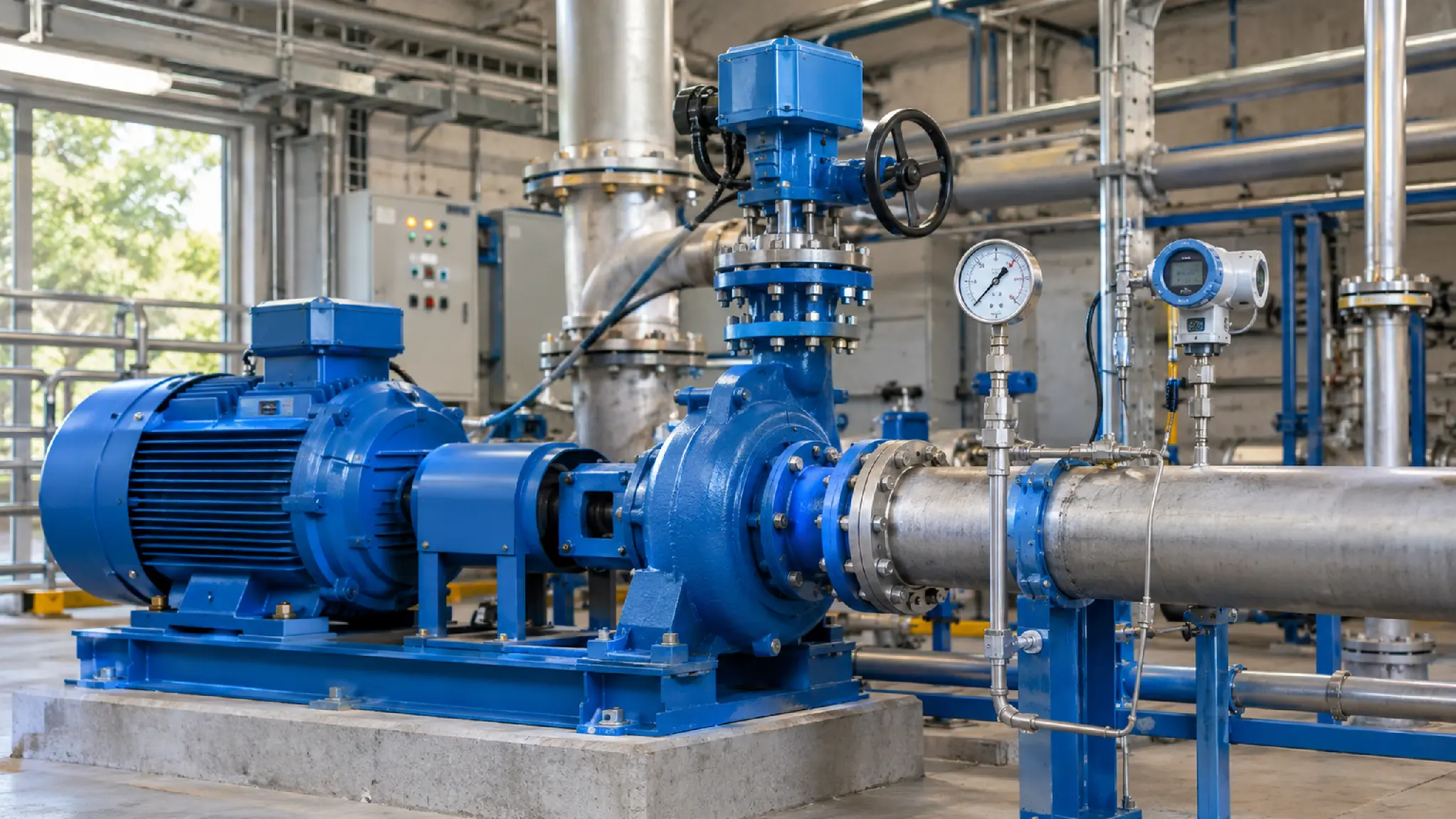
This application focuses on a VFD-driven centrifugal pump at a municipal water treatment or distribution pumping station. The bounded action is a change to the pump speed reference within a site-approved operating envelope. The target may be one duty pump serving a defined pressure zone or transfer route. The exact equipment, operating range, and control interface must be confirmed for the facility before any command workflow is designed.
The workflow does not replace pump protection, motor protection, pressure relief, hardwired interlocks, or the programmable logic controller’s (PLC’s) validated control functions. It does not establish authority to start or stop equipment, change protective settings, or operate outside approved limits. Those actions require separate engineering review and explicit authorization.
Use Operating Data to Establish Whether an Adjustment Is Appropriate
A decision proposal should be based on current, time-aligned information associated with the correct pump and station. Depending on the site design, relevant inputs may include:
Hydraulic measurements
Discharge pressure and flow rate, interpreted against the service requirement for the pressure zone or transfer route.
Suction pressure, wet-well or reservoir level, and other available indicators of supply conditions.
Equipment state
Pump status, measured motor speed, motor current, VFD status, and relevant equipment alarms.
Operating mode, duty and standby assignments, maintenance restrictions, and approved operating schedules.
Data quality and decision conditions
Sensor quality flags, timestamps, communications status, and the age of the latest valid observations.
Rules or an AI-supported decision function may assess whether a proposed setpoint change is consistent with demand and operating constraints. The decision process should identify the observations it used, the applicable limits, the requested adjustment, and any uncertainty. If required data are stale, missing, contradictory, or outside the conditions used for evaluation, the system should withhold the proposal or route it for additional operator review rather than infer that the action is safe.
Site-validated control connection
A typical design may pass an approved supervisory setpoint request through an authorized gateway or control interface to the VFD or PLC. The integration must specify the pump identifier, requested setpoint, units, valid range, command expiry, requesting system, approver, and unique command identifier. The actual interface and supported command semantics require site-specific validation.
Record each stage of execution
A command acknowledgment confirms only that the receiving interface accepted or processed a message. It does not prove that the pump achieved the requested speed or that the station delivered the expected flow or pressure. The workflow should separately record command dispatch, acknowledgment, observed equipment response, and the final verification result.
Keep Human Authority and Protective Controls in the Execution Path
For an initial operational design, a control room operator or shift supervisor should review and approve each proposed setpoint change. A controls engineer should define the permitted range, equipment-specific constraints, and behavior for abnormal conditions. The authority model should make clear who may request, approve, cancel, and override an action, and how those decisions are recorded.
Execution requirements
Reject commands when the pump is unavailable, in a prohibited mode, under maintenance restriction, or outside the approved operating envelope.
Require fresh, valid measurements and confirm that the target pump and control point match the approved request.
Handle duplicate requests idempotently so a repeated message does not cause an unintended second action.
Expire commands that are not acknowledged within the defined response period and report the timeout to the operator.
Preserve local and independent protective functions, manual control, emergency procedures, and operator override.
Define a safe response to communications loss, conflicting commands, unexpected equipment response, or a failed verification check.
Autonomous execution, if considered later, should be limited to a separately reviewed operating envelope and validated against site-specific failure scenarios. A software workflow or simulation does not establish that physical deployment is safe, certified, or ready for unattended operation.
Verify the Physical Outcome, Not Just the Command
After dispatch, the workflow should compare the requested state with independently observed equipment and process conditions. Depending on the installation, verification may use measured pump speed, VFD status, motor current, discharge pressure, and flow. The verification rule should account for the expected response time and normal process variation. It should distinguish a successful command acknowledgment from a verified physical outcome.
If the pump does not reach the requested state, reaches it only partially, or causes an unexpected pressure or flow response, the event should be recorded as failed or unresolved. The workflow should notify the responsible operator and follow the facility’s approved recovery procedure. It should not automatically retry or issue a different command unless that behavior has been explicitly engineered and authorized.
Test conditions
The baseline may involve an operator reviewing station readings and entering a setpoint through the established control system. Evaluation should include normal demand changes, low-supply conditions, sensor faults, equipment unavailability, network interruptions, and operator overrides.
Useful measures
Verified action rate: eligible attempted actions confirmed by observed equipment and process outcomes, divided by eligible attempted actions.
Command rejection and timeout rates, with causes grouped by validation, authority, equipment state, and communications.
Constraint violations, including any excursion beyond the approved operating envelope.
Time from a valid proposal to operator decision, command acknowledgment, and verified outcome.
Frequency of human intervention, manual override, failed execution, partial execution, and recovery.
Pump operating stability and service measures relevant to the site, such as pressure or flow compliance, assessed over a defined period.
Reporting discipline
Report adverse outcomes and unresolved actions alongside successful outcomes. Define each measure’s unit, denominator, time window, exclusions, and aggregation method before testing. Do not infer energy savings, reduced wear, or improved service from a successful command alone. Those outcomes require an evaluation design that accounts for pump efficiency, hydraulic conditions, demand, equipment behavior, and the consequences of the intervention.
Prepare for Site-Specific Integration and Validation
Before a pilot, the utility should identify the selected pump and VFD, relevant PLC and supervisory control and data acquisition (SCADA) interfaces, available historian records, sensor calibration status, operating procedures, and ownership of each control point. The integration review should cover network segmentation, user and service account permissions, command logging, time synchronization, data retention, and recovery after a communications outage. Compatibility with any named controller, VFD, protocol, or enterprise system must be verified rather than assumed.
The first evaluation can run in advisory or operator-approved mode without issuing physical commands. A later controlled test should proceed only after engineering approval, hazard review, test planning, commissioning checks, and confirmation that independent protective functions remain effective. Any simulation-based study should be labeled as such and should not be presented as evidence of an actual customer deployment.

Discuss an Authorized Pump Control Workflow
UtilityGrid can discuss how Physical AI and Artificial Intelligence of Things (AIoT) concepts may be evaluated for a defined pumping-station workflow. A useful first discussion identifies the pump and control boundary, the operating data available, the approval roles, the existing protective functions, and the evidence required to confirm an action. The proposed design and its implementation status should be reviewed before any deployment or capability claim is made.